
Present Value Calculator
See what future money is worth in today's terms
Enter the amount and rate
Free · No sign-up · Updates as you type
$
The single future payment, e.g. 100,000.
What this money could earn elsewhere, e.g. 8 for 8%. Finance calls it the discount rate.
How far in the future, in years, e.g. 10. Up to 100.
What $100,000 in 10 years is worth today
$46,319
If your money could earn 8% a year instead, $100,000 arriving in 10 years is worth $46,319 today (its present value). Put the other way round, $46,319 put aside today at 8% a year would grow to $100,000 by then. So at that return, more than $46,319 in your hand today beats waiting, and less than $46,319 does not.
The numbers behind that
The difference
What $46,319 would earn in 10 years at 8% a year. It is not a fee and nobody takes it: it is why the later amount has to be bigger.
$53,681
What changes it most
Click a line to jump to the field you would change.
This uses only the three figures above. It does not allow for tax or rising prices, and it treats the later payment as certain.
How the value changes with the return you could earn
The return you could earn instead is a guess, and the answer moves a lot with it. Here is the same future money valued at a range of returns.
| Yearly return you could earn | Worth today |
|---|---|
| 4% | $67,556 |
| 6% | $55,839 |
| 8% (yours) | $46,319 |
| 10% | $38,554 |
| 12% | $32,197 |
Insight: Present value is the foundation of nearly all investment valuation. The higher the discount rate, or the longer you wait, the less a future amount is worth today. When you compare two options that pay off at different times, converting both to present value puts them on the same footing.
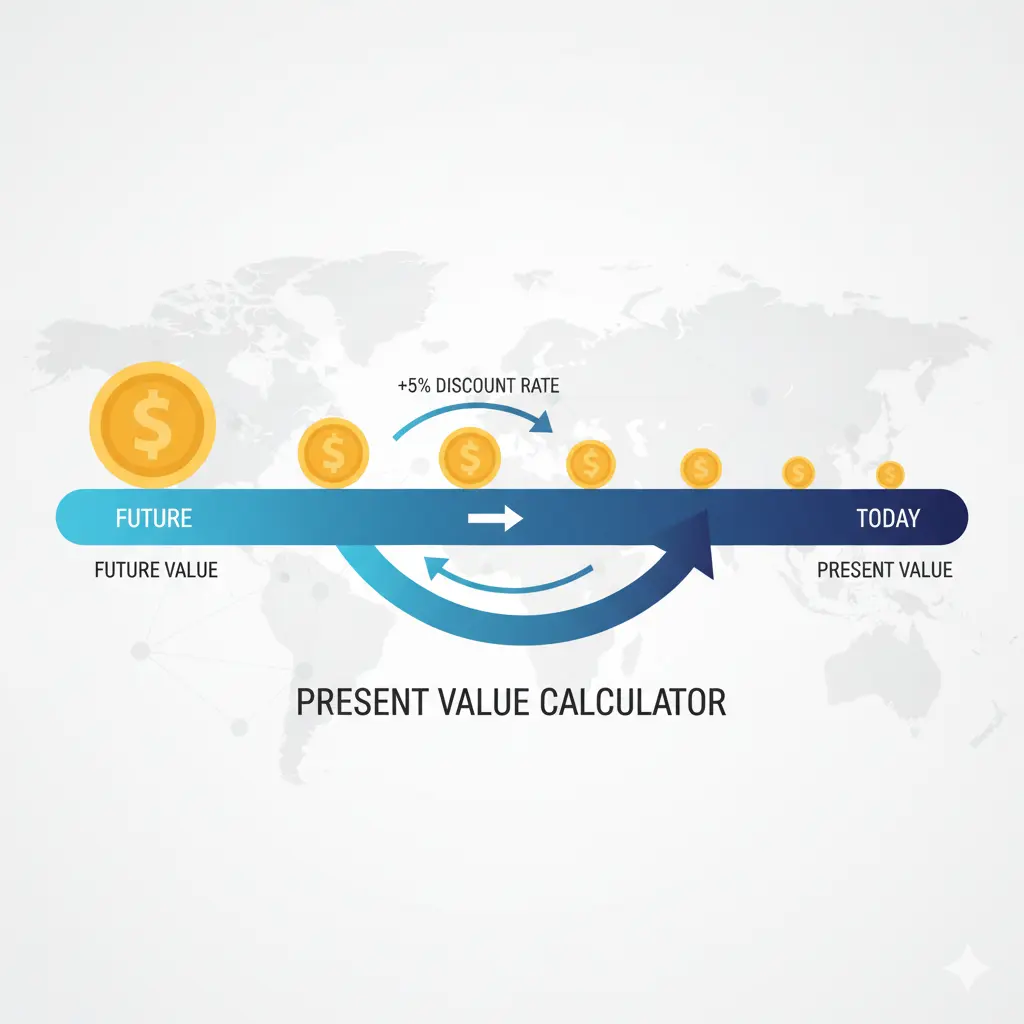
Present value is the cornerstone of the time value of money. A dollar today is worth more than a dollar in the future, because today's dollar can be invested and earn a return. This calculator discounts future cash flows back to their equivalent value today.
PV = FV / (1 + r)^n
Step 1: Choose whether you are valuing one future sum or a series of repeating payments (an annuity).
Step 2: Enter the amount you will receive (or the amount of each payment), the yearly return you could earn instead, and the number of years.
Step 3: For repeating payments, choose how often you are paid: once a year, every six months, every quarter, or every month. A single future sum is discounted once a year.
Step 4: What the money is worth today, the difference, and a table of other returns appear as you type, with no button to press.
What Is Present Value?
Present value answers a simple but powerful question: what is a future amount of money worth right now? It rests on the time value of money, the idea that a dollar today is worth more than a dollar later, because the dollar you hold now can be invested and earn a return. To compare money that arrives at different times, you first have to bring it all back to the same point: today.
This idea runs through almost all of finance. It is used to price bonds, to value the cash flows of a business, to compare a lump sum against an instalment plan, and to decide whether a future payout is worth more than money in hand today. Any time the timing of a cash flow matters, present value is the tool that levels the playing field.
The Present Value Formula
PV = FV / (1 + r)^n
For a single future sum, the present value divides the future amount by one plus the yearly rate, raised to the number of years. This calculator discounts a single sum once a year. The longer the wait and the higher the rate, the smaller the present value.
For an annuity, a series of equal payments at regular intervals, the present value adds up the discounted value of each individual payment. Rather than discounting every payment separately, the formula simplifies to PV = PMT × [(1 − (1 + i)^−N) / i], where PMT is one payment, i is the yearly rate divided by the number of payments in a year, and N is the number of payments. Each payment is counted at the end of its interval. This is what the calculator uses in its repeating-payments mode.
A Worked Example
Suppose someone offers to pay you $100,000 in ten years. If your money could otherwise earn 8% a year, the present value is 100,000 ÷ (1.08)^10, which works out to about $46,319. In other words, you would only need to set aside roughly $46,319 today, growing at 8%, to end up with $100,000 in a decade. The difference, about $53,681, is what that $46,319 would earn over the ten years.
Now take the repeating-payments case: $1,000 a year for ten years at the same 8% rate. The payments add up to $10,000 on paper, but their present value is only about $6,710, because each later payment is worth less than the one before it. The first $1,000 barely needs discounting; the tenth is discounted by a full decade. This is why a stream of future income is always worth less than the same total received today.
How Present Value Is Used in Investing
Bond pricing is one of the most direct uses. A bond's fair price is simply the present value of its future coupon payments plus the present value of the face value returned at maturity. This is also why bond prices fall when interest rates rise: a higher discount rate lowers the present value of every future payment the bond will make.
In stock valuation, the discounted cash flow model estimates a company's worth as the present value of its projected future free cash flows. Present value also settles everyday choices: deciding between $100,000 today and $150,000 in five years, or between a lump-sum pension and a monthly annuity, comes down to discounting each option at a realistic rate and comparing the results.
What to Watch Out For
The result is only as good as the discount rate you choose, and that rate is a judgement call rather than a fact. A small change in it can move the present value substantially, especially over long horizons, which is exactly why the calculator shows a sensitivity table across a range of rates. Treat the present value as a considered estimate, not a precise figure, and always test how the answer holds up if your assumptions turn out to be a little optimistic.
Using Present Value Alongside Other Tools
Present value is the engine behind several other tools. To add up the present values of an investment's cash flows and subtract its upfront cost, use our NPV calculator and to turn a company's projected cash flows into a per-share value, use the DCF calculator.
The discount rate you plug in matters more than any other input. To estimate a realistic rate from a company's mix of debt and equity, work it out with our WACC calculator before discounting any cash flows back to today.
Frequently Asked Questions
The discount rate is the return you could earn elsewhere on money of similar risk, so it depends on what you are comparing. For a near risk-free benchmark, use the current yield on a government bond that lasts about as long as your wait. For judging a business or investment, use your required rate of return, or its weighted average cost of capital (WACC). If you only care about keeping up with prices, use the inflation rate you expect. The present value is very sensitive to this figure, so it is worth trying a range rather than trusting a single number.
Present value (PV) discounts a single future amount, or a stream of equal payments, back to what it is worth today. Net present value (NPV) goes one step further: it adds up the present values of all of an investment's cash flows and then subtracts the upfront cost you pay to get them. In short, PV tells you what future money is worth now; NPV tells you whether an investment creates value after you have paid for it. A positive NPV means the expected return clears your discount rate.
Yes. For repeating payments this calculator divides your yearly rate by the number of payments in a year, so 8% a year with monthly payments is applied as 0.667% a month, which compounds to about 8.30% a year. The result shows both figures. A single future sum is always discounted once a year here.
Use the one-future-sum mode when there is a single future payment, for example a bond that returns its face value at maturity, or a payout you expect to receive once in several years. Use the repeating-payments mode when you receive the same amount again and again at regular intervals, such as a pension, a fixed annual dividend, or rent. There you choose how often you are paid, and the amount you type is one payment: choose every month and it is treated as a monthly payment, counted at the end of each month.
Because a dollar in your hand today can be invested to earn a return, so it grows into more than a dollar by next year. Waiting also carries risk and gives up the use of the money in the meantime. Present value simply runs that logic backwards: it asks how much you would need to set aside today, at your chosen rate, to end up with the future amount. The longer the wait and the higher the rate, the less that future money is worth right now.
Track the Value of Your Entire Portfolio
Understanding present value is the first step. With a free Worthmap account, you can record what you own in each currency, see your net worth in one base currency over time, and use the stock screener and AI analysis. The free plan is in beta.
Create free accountBuilt & maintained by Worthmap · Last updated October 6, 2026
Educational use only. This tool provides estimates for informational purposes and does not constitute financial, investment, tax, or legal advice. Results are based on inputs you provide and mathematical models, they do not guarantee future performance. Always consult a qualified financial adviser before making investment decisions.