
Calculateur de valeur actuelle
Voyez ce que vaut aujourd'hui de l'argent futur
Saisissez le montant et le taux
Gratuit · Sans inscription · Se met à jour à la saisie
€
Le versement futur unique, p. ex. 100 000.
Ce que cet argent pourrait rapporter ailleurs, p. ex. 8 pour 8 %. En finance, on l'appelle le taux d'actualisation.
Dans combien de temps, en années, p. ex. 10. Jusqu'à 100.
Ce que valent aujourd'hui 100 000 € reçus dans 10 ans
46 319 €
Si votre argent pouvait rapporter 8 % par an à la place, 100 000 € reçus dans 10 ans valent 46 319 € aujourd'hui (leur valeur actuelle). Dans l'autre sens, 46 319 € mis de côté aujourd'hui à 8 % par an deviendraient 100 000 € à cette date. À ce rendement, donc, recevoir plus de 46 319 € tout de suite vaut mieux qu'attendre, et recevoir moins de 46 319 €, non.
Les chiffres derrière ce résultat
La différence
Ce que 46 319 € rapporteraient en 10 ans à 8 % par an. Ce ne sont pas des frais et personne ne les prélève : c'est la raison pour laquelle le montant reçu plus tard doit être plus élevé.
53 681 €
Ce qui fait le plus bouger ce chiffre
Cliquez sur une ligne pour aller au champ que vous modifieriez.
Ce calcul n'utilise que les trois chiffres ci-dessus. Il ne tient compte ni des impôts ni de la hausse des prix, et il considère le versement futur comme certain.
Comment la valeur évolue selon le rendement que vous pourriez obtenir
Le rendement que vous pourriez obtenir à la place est une estimation, et la réponse bouge beaucoup avec lui. Voici le même argent futur valorisé pour plusieurs rendements.
| Rendement annuel possible ailleurs | Valeur aujourd'hui |
|---|---|
| 4 % | 67 556 € |
| 6 % | 55 839 € |
| 8 % (le vôtre) | 46 319 € |
| 10 % | 38 554 € |
| 12 % | 32 197 € |
À retenir : La valeur actuelle est le socle de presque toute valorisation d'investissement. Plus le taux d'actualisation est élevé, ou plus l'attente est longue, moins un montant futur vaut aujourd'hui. Lorsque vous comparez deux options qui rapportent à des moments différents, ramener les deux à leur valeur actuelle les met sur un pied d'égalité.
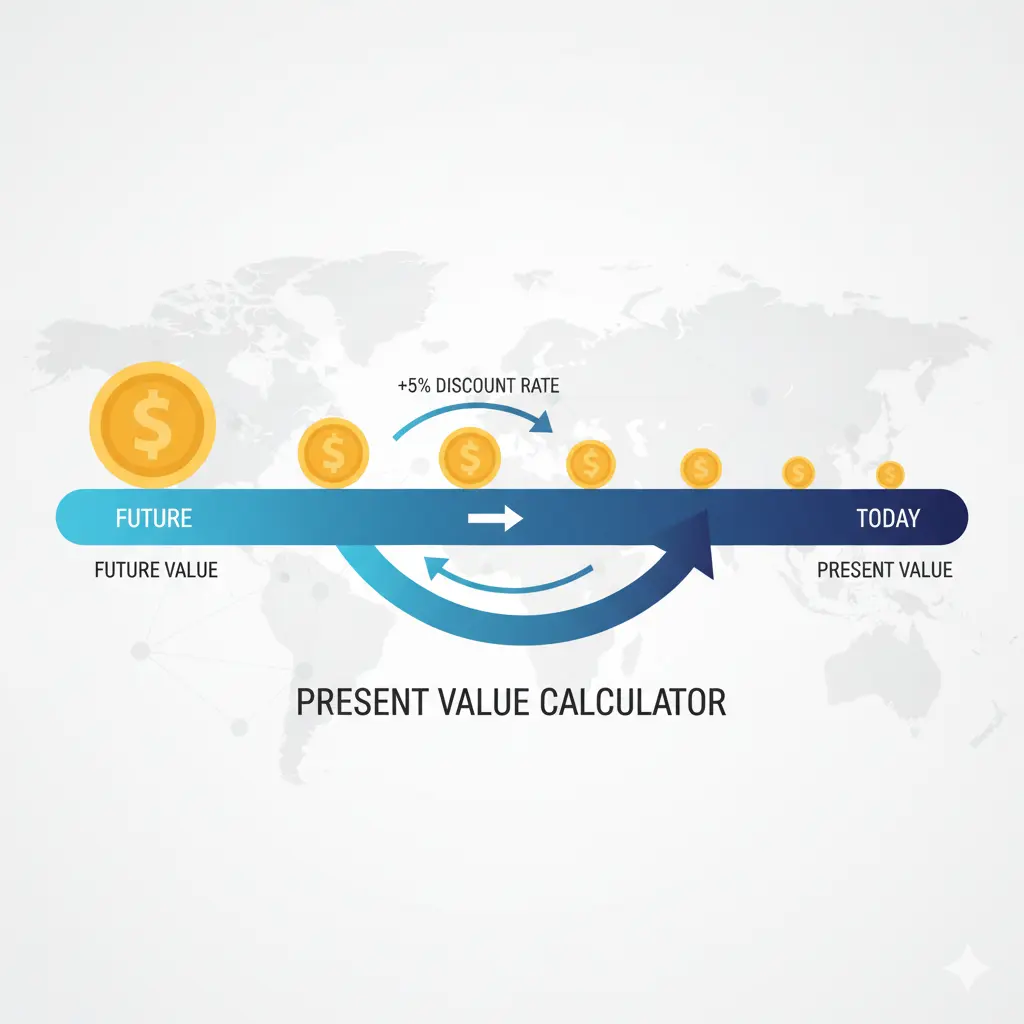
La valeur actuelle est la pierre angulaire de la valeur temps de l'argent. Un dollar aujourd'hui vaut plus qu'un dollar demain, car le dollar d'aujourd'hui peut être investi et rapporter un rendement. Ce calculateur actualise les flux de trésorerie futurs pour les ramener à leur valeur équivalente d'aujourd'hui.
PV = FV / (1 + r)^n
Étape 1 : Choisissez si vous valorisez une somme future unique ou une série de versements réguliers (une rente).
Étape 2 : Saisissez le montant que vous recevrez (ou le montant de chaque versement), le rendement annuel que vous pourriez obtenir à la place et le nombre d'années.
Étape 3 : Pour des versements réguliers, choisissez à quelle fréquence vous êtes payé : une fois par an, tous les six mois, chaque trimestre ou chaque mois. Une somme future unique est actualisée une fois par an.
Étape 4 : Ce que l'argent vaut aujourd'hui, la différence et un tableau avec d'autres rendements s'affichent à la saisie, sans aucun bouton à presser.
Qu'est-ce que la valeur actuelle ?
La valeur actuelle répond à une question simple mais puissante : que vaut aujourd'hui une somme d'argent future ? Elle repose sur la valeur temps de l'argent, l'idée qu'un dollar aujourd'hui vaut plus qu'un dollar plus tard, car le dollar que vous détenez maintenant peut être investi et rapporter un rendement. Pour comparer des sommes qui arrivent à des moments différents, il faut d'abord toutes les ramener au même point : aujourd'hui.
Cette idée traverse presque toute la finance. Elle sert à fixer le prix des obligations, à valoriser les flux de trésorerie d'une entreprise, à comparer un capital unique à un paiement échelonné, et à décider si un versement futur vaut mieux que de l'argent disponible aujourd'hui. Dès que le calendrier d'un flux compte, la valeur actuelle est l'outil qui remet tout sur un pied d'égalité.
La formule de la valeur actuelle
PV = FV / (1 + r)^n
Pour une somme future unique, la valeur actuelle divise le montant futur par un plus le taux annuel, élevé au nombre d'années. Ce calculateur actualise une somme unique une fois par an. Plus l'attente est longue et plus le taux est élevé, plus la valeur actuelle est faible.
Pour une rente, c'est-à-dire une série de versements égaux à intervalles réguliers, la valeur actuelle additionne la valeur actualisée de chaque versement pris séparément. Plutôt que d'actualiser chaque versement un à un, la formule se simplifie en PV = PMT × [(1 − (1 + i)^−N) / i], où PMT est un versement, i le taux annuel divisé par le nombre de versements dans l'année, et N le nombre de versements. Chaque versement est compté à la fin de son intervalle. C'est ce que le calculateur utilise dans son mode versements réguliers.
Un exemple chiffré
Supposons que quelqu'un vous propose de vous verser 100 000 $ dans dix ans. Si votre argent pouvait autrement rapporter 8 % par an, la valeur actuelle est 100 000 ÷ (1,08)^10, soit environ 46 319 $. Autrement dit, il vous suffirait de mettre de côté environ 46 319 $ aujourd'hui, en les faisant croître à 8 %, pour obtenir 100 000 $ dans une décennie. La différence, environ 53 681 $, est ce que ces 46 319 $ rapporteraient sur les dix ans.
Prenons maintenant le cas des versements réguliers : 1 000 $ par an pendant dix ans, au même taux de 8 %. Les versements totalisent 10 000 $ sur le papier, mais leur valeur actuelle n'est que d'environ 6 710 $, car chaque versement plus tardif vaut moins que le précédent. Les premiers 1 000 $ n'ont presque pas besoin d'être actualisés ; le dixième l'est sur une décennie entière. C'est pourquoi un flux de revenus futurs vaut toujours moins que le même total reçu aujourd'hui.
Comment la valeur actuelle est utilisée en investissement
La valorisation des obligations en est l'une des applications les plus directes. Le juste prix d'une obligation est simplement la valeur actuelle de ses coupons futurs, plus la valeur actuelle de la valeur nominale remboursée à l'échéance. C'est aussi pourquoi le cours des obligations baisse quand les taux d'intérêt montent : un taux d'actualisation plus élevé abaisse la valeur actuelle de chaque versement futur que l'obligation effectuera.
En valorisation des actions, le modèle d'actualisation des flux de trésorerie estime la valeur d'une entreprise comme la valeur actuelle de ses flux de trésorerie disponibles futurs projetés. La valeur actuelle tranche aussi des choix du quotidien : décider entre 100 000 $ aujourd'hui et 150 000 $ dans cinq ans, ou entre une pension versée en capital et une rente mensuelle, revient à actualiser chaque option à un taux réaliste et à comparer les résultats.
Les points de vigilance
Le résultat ne vaut que ce que vaut le taux d'actualisation que vous choisissez, et ce taux relève du jugement plus que du fait. Une légère variation peut déplacer la valeur actuelle de façon notable, surtout sur de longs horizons : c'est précisément pourquoi le calculateur affiche un tableau de sensibilité sur une fourchette de taux. Considérez la valeur actuelle comme une estimation réfléchie, et non comme un chiffre précis, et vérifiez toujours comment le résultat tient si vos hypothèses se révèlent un peu optimistes.
Utiliser la valeur actuelle avec d'autres outils
La valeur actuelle est le moteur de plusieurs autres outils. Pour additionner les valeurs actuelles des flux de trésorerie d'un investissement et en soustraire le coût initial, utilisez notre calculateur NPV et pour convertir les flux de trésorerie projetés d'une entreprise en une valeur par action, utilisez le calculateur DCF.
Le taux d'actualisation que vous saisissez compte plus que toute autre donnée. Pour estimer un taux réaliste à partir du mélange de dette et de capitaux propres d'une entreprise, calculez-le avec notre calculateur WACC avant d'actualiser le moindre flux de trésorerie à aujourd'hui.
Foire aux questions
Le taux d'actualisation correspond au rendement que vous pourriez obtenir ailleurs sur un placement de risque comparable : il dépend donc de ce que vous comparez. Pour un repère proche du sans-risque, prenez le rendement actuel d'une obligation d'État dont la durée est proche de votre attente. Pour juger une entreprise ou un investissement, utilisez votre taux de rendement exigé, ou son coût moyen pondéré du capital (WACC). Si vous cherchez seulement à suivre la hausse des prix, utilisez le taux d'inflation que vous attendez. La valeur actuelle est très sensible à ce chiffre : mieux vaut donc essayer une fourchette plutôt que de vous fier à un seul nombre.
La valeur actuelle (PV) actualise un montant futur unique, ou une série de versements égaux, pour ramener leur valeur à aujourd'hui. La valeur actuelle nette (NPV) va un cran plus loin : elle additionne les valeurs actuelles de tous les flux de trésorerie d'un investissement, puis en retranche le coût initial que vous payez pour les obtenir. En bref, la PV vous dit ce que vaut aujourd'hui de l'argent futur ; la NPV vous dit si un investissement crée de la valeur une fois que vous l'avez payé. Une NPV positive signifie que le rendement attendu dépasse votre taux d'actualisation.
Oui. Pour des versements réguliers, ce calculateur divise votre taux annuel par le nombre de versements dans l'année : 8 % par an avec des versements mensuels s'appliquent donc à raison de 0,667 % par mois, ce qui, cumulé, fait environ 8,30 % par an. Le résultat affiche les deux chiffres. Ici, une somme future unique est toujours actualisée une fois par an.
Utilisez le mode « Une somme future » lorsqu'il y a un seul versement futur, par exemple une obligation qui rembourse sa valeur nominale à l'échéance, ou un capital que vous attendez une seule fois dans quelques années. Utilisez le mode « Versements réguliers » lorsque vous recevez le même montant encore et encore à intervalles réguliers, comme une pension, un dividende annuel fixe ou un loyer. Vous y choisissez à quelle fréquence vous êtes payé, et le montant que vous saisissez est celui d'un versement : choisissez chaque mois, et il est traité comme un versement mensuel, compté à la fin de chaque mois.
Parce qu'un dollar que vous avez en main aujourd'hui peut être investi pour rapporter un rendement : il se transforme donc en plus d'un dollar d'ici l'an prochain. Attendre comporte aussi un risque et vous prive de l'usage de l'argent dans l'intervalle. La valeur actuelle ne fait qu'appliquer ce raisonnement à l'envers : elle demande combien vous devriez mettre de côté aujourd'hui, au taux que vous avez choisi, pour obtenir le montant futur. Plus l'attente est longue et plus le taux est élevé, moins cet argent futur vaut aujourd'hui.
Suivez la valeur de tout votre portefeuille
Comprendre la valeur actuelle est la première étape. Avec un compte Worthmap gratuit, vous pouvez enregistrer ce que vous possédez dans chaque devise, voir votre patrimoine net dans une devise de base au fil du temps, et utiliser le screener d'actions et l'analyse par IA. Le plan gratuit est en version bêta.
Créer un compte gratuitConçu et maintenu par Worthmap · Dernière mise à jour 6 octobre 2026
À usage pédagogique uniquement. Cet outil fournit des estimations à titre informatif et ne constitue pas un conseil financier, d'investissement, fiscal ou juridique. Les résultats reposent sur les données que vous saisissez et sur des modèles mathématiques ; ils ne garantissent pas les performances futures. Consultez toujours un conseiller financier qualifié avant de prendre des décisions d'investissement.