
Calculateur d'intérêts composés
Découvrez comment vos investissements croissent dans le temps grâce à la puissance des intérêts composés
Saisissez votre plan et voyez ce qu'il devient
Gratuit · Sans inscription · Se met à jour à la saisie
$
Votre montant de départ. Peut être 0.
$
Ajouté chaque mois. Peut être 0.
Rendement de long terme, p. ex. 8 pour 8 %. Le S&P 500 a rapporté environ 10 % en moyenne.
Combien de temps vous restez investi, p. ex. 20.
L'argent que vous ajoutez est compté à la fin de chaque période : avec une croissance ajoutée une fois par an, tous les versements de l'année arrivent donc en fin d'année.
Ce que vous auriez à la fin
343 778 $
au bout de 20 ans
Sur ce total, 130 000 $ est de l'argent que vous avez versé vous-même. Les 213 778 $ restants sont de la croissance.
Les chiffres derrière ce résultat
Argent versé
10 000 $ au départ, plus 500 $ par mois pendant 20 ans, soit 120 000 $.
130 000 $
Croissance en plus
62,2 % de ce que vous auriez à la fin. C'est la croissance de votre argent et la croissance de la croissance déjà acquise (les intérêts composés), à 8,0 % par an, ajoutée chaque mois. À 8,0 % par an, l'argent double environ tous les 9 ans (la règle de 72, une estimation approximative).
213 778 $
Vrai taux annuel, capitalisation comprise
8,0 % par an, ajoutés chaque mois, donnent 8,30 % sur une année complète, car la croissance ajoutée en cours d'année produit elle aussi de la croissance.
8,30 %
Ce qui changerait le résultat
Cliquez sur une ligne pour aller au champ dont elle parle.
- Laissez-le 5 ans de plus, 25 ans en tout, et vous auriez 548 915 $ : 205 137 $ de plus, dont 30 000 $ d'argent supplémentaire versé par vous.
- Versez 600 $ par mois au lieu de 500 $ et, au bout de 20 ans, vous auriez 402 680 $ : 58 902 $ de plus, dont 24 000 $ correspondent à l'argent supplémentaire lui-même.
- Le rendement est une supposition. À 7,0 % par an, vous auriez 300 851 $ ; à 9,0 % par an, 394 035 $.
Ce que ces montants permettront d'acheter
C'est le montant que vous verriez sur votre relevé au bout de 20 ans, pas ce qu'il permettra d'acheter. Les prix augmentent entre-temps. Pour voir le résultat en prix d'aujourd'hui, retirez du rendement annuel l'inflation que vous prévoyez : avec un rendement de 8 % et une inflation de 3 %, saisissez 5.
Ce que changerait un autre rendement
Comment ajouter un rendement à comparer
Ajoutez un autre rendement annuel et voyez de combien le résultat final bouge. De petits écarts finissent par peser lourd sur des décennies.
%
8% (votre taux)
5%
10%
Versements
| Rendement annuel | Vous finiriez avec | Croissance | Par rapport à votre taux |
|---|---|---|---|
| 10% | 452 965 $ | 322 965 $ | +109 187 $ |
| 8% (votre taux) | 343 778 $ | 213 778 $ | le vôtre |
| 5% | 232 643 $ | 102 643 $ | -111 135 $ |
De petites différences se composent en sommes qui changent une vie. Comme vous pouvez le voir ci-dessus, même une différence de 1 à 2 % dans les rendements annuels peut représenter des dizaines ou des centaines de milliers de dollars sur un long horizon d'investissement. La question est : comment augmentez-vous vos rendements ? Les calculateurs du Nombre de Graham et de la marge de sécurité de ce site vous aident à juger si une action a un prix raisonnable avant de l'acheter.
Explorez les outils d'investissement gratuits de Worthmap →Année par année
| Année | Argent versé jusque-là | Croissance | Total en fin d'année |
|---|---|---|---|
| 1 | 16 000 $ | 1 055 $ | 17 055 $ |
| 2 | 22 000 $ | 2 695 $ | 24 695 $ |
| 3 | 28 000 $ | 4 970 $ | 32 970 $ |
| 4 | 34 000 $ | 7 932 $ | 41 932 $ |
| 5 | 40 000 $ | 11 637 $ | 51 637 $ |
| ··· | |||
| 16 | 106 000 $ | 123 419 $ | 229 419 $ |
| 17 | 112 000 $ | 142 685 $ | 254 685 $ |
| 18 | 118 000 $ | 164 049 $ | 282 049 $ |
| 19 | 124 000 $ | 187 684 $ | 311 684 $ |
| 20 | 130 000 $ | 213 778 $ | 343 778 $ |
À retenir : Les intérêts composés récompensent le temps. Plus votre argent reste investi longtemps, plus sa croissance vient de la croissance qu'il a déjà produite, et c'est pourquoi la courbe monte plus vite dans les dernières années. Commencer tôt donne davantage de ces années à chaque somme que vous investissez : la même épargne, commencée dix ans plus tôt, peut finir bien plus importante.
Les intérêts composés sont le processus par lequel on gagne des intérêts à la fois sur le capital initial et sur les intérêts déjà accumulés. Contrairement aux intérêts simples (calculés uniquement sur le montant initial), les intérêts composés font croître votre patrimoine de façon exponentielle dans le temps. Albert Einstein les aurait qualifiés de huitième merveille du monde.
FV = P(1 + r/n)^(nt) + PMT × [((1 + r/n)^(nt) - 1) / (r/n)]
Étape 1 : Saisissez le montant de votre investissement initial (le capital de départ). Il peut être nul si vous partez de zéro.
Étape 2 : Saisissez votre versement mensuel, le montant que vous prévoyez d'ajouter chaque mois via un investissement programmé (dollar cost averaging) ou un plan d'investissement systématique.
Étape 3 : Définissez votre taux de rendement annuel attendu. La moyenne historique du S&P 500 est d'environ 10 %, même si de nombreux planificateurs utilisent 7 à 8 % pour tenir compte de l'inflation.
Étape 4 : Choisissez votre durée d'investissement et la fréquence de capitalisation. La projection et le détail année par année se mettent à jour instantanément à la saisie.
Qu'est-ce que les intérêts composés ?
Les intérêts composés sont le mécanisme par lequel les gains de votre investissement génèrent à leur tour leurs propres gains. Lorsque vous investissez 10 000 $ à un rendement annuel de 8 %, vous gagnez 800 $ la première année. La deuxième année, vous gagnez 8 % sur 10 800 $, soit 864 $. À la 20e année, vos seuls gains annuels dépassent votre investissement initial. Cette croissance exponentielle est le fondement de la constitution d'un patrimoine sur le long terme.
Les variables clés qui déterminent la croissance composée sont le capital, le taux de rendement, la fréquence de capitalisation et, surtout, le temps. Plus votre argent se capitalise longtemps, plus les résultats sont spectaculaires. C'est pourquoi un calculateur d'investissement pour la croissance composée est l'un des outils les plus importants pour quiconque prépare son avenir financier, que vous épargniez pour la retraite, pour un achat important ou pour atteindre votre chiffre d'indépendance financière.
Investissement programmé et intérêts composés
L'investissement programmé (dollar cost averaging, DCA), c'est-à-dire investir un montant fixe à intervalles réguliers, est l'une des stratégies les plus efficaces pour constituer un patrimoine dans le temps. Ce calculateur de dollar cost averaging montre comment même de modestes versements mensuels peuvent croître en sommes substantielles lorsqu'ils sont combinés aux intérêts composés. Un plan d'investissement systématique de 500 $ par mois à 8 % de rendement annuel croît à environ 475 000 $ en 25 ans, alors que vous n'avez versé que 150 000 $. Utilisez-le comme calculateur de plan d'investissement systématique pour modéliser votre propre stratégie de DCA.
L'avantage de l'investissement programmé est qu'il supprime le besoin d'anticiper les mouvements du marché. En investissant régulièrement, vous achetez plus de parts quand les prix sont bas et moins quand ils sont élevés, ce qui lisse naturellement votre prix de revient. Combinée aux intérêts composés, cette approche disciplinée a historiquement surperformé la plupart des stratégies de trading actif sur de longs horizons de temps.
Les intérêts composés pour préparer la retraite
Un calculateur d'investissement pour préparer la retraite vous aide à répondre à la question financière la plus importante : en aurai-je assez ? En projetant votre épargne actuelle et vos versements à un taux de rendement réaliste, vous pouvez voir si vous êtes sur la bonne voie pour atteindre votre nombre d'indépendance financière, et comment modifier vos versements ou votre échéance change le résultat. Pour l'utiliser en vue de la retraite, modifiez le montant mensuel ou le nombre d'années jusqu'à ce que le résultat final atteigne le capital que vous visez.
Pour celles et ceux qui visent l'indépendance financière, ce calculateur est essentiel pour la planification Coast FIRE (où vos investissements croissent jusqu'à votre objectif sans versements supplémentaires) et Barista FIRE (où un revenu à temps partiel couvre les dépenses pendant que les investissements se capitalisent). La différence entre partir à la retraite à 55 ans plutôt qu'à 65 ans tient souvent à quelques années de capitalisation supplémentaires.
Questions fréquentes sur le calculateur d'intérêts composés
Le taux approprié dépend de votre allocation d'actifs. Le S&P 500 a historiquement rapporté environ 10 % par an avant inflation (environ 7 % après inflation). Un portefeuille diversifié d'actions et d'obligations rapporte généralement 6 à 8 %. Pour des estimations prudentes, utilisez 6 à 7 %. Pour des projections optimistes, 9 à 10 %. Testez toujours plusieurs scénarios pour comprendre l'éventail des résultats possibles.
Une capitalisation plus fréquente signifie que vos intérêts commencent plus tôt à produire des intérêts, ce qui augmente légèrement votre rendement total. Par exemple, 10 000 $ à 8 % sur 20 ans croissent à 46 610 $ avec une capitalisation annuelle, mais à 49 522 $ avec une capitalisation quotidienne, soit une différence d'environ 2 912 $ (6,2 % de plus). L'effet est plus marqué avec des taux élevés et de longs horizons de temps.
La règle de 72 est une astuce de calcul mental rapide pour estimer le temps nécessaire pour doubler votre argent. Divisez 72 par votre taux de rendement annuel pour obtenir le temps de doublement approximatif. À 8 %, votre argent double en environ 9 ans (72 ÷ 8 = 9). À 10 %, il double en environ 7,2 ans. À 6 %, environ 12 ans. Cette règle vous aide à jauger rapidement la puissance de la capitalisation à différents taux.
Oui, surtout pour la planification à long terme. Vous pouvez soit utiliser un taux de rendement "réel" (taux nominal moins inflation, généralement 2 à 3 %), soit calculer en termes nominaux et ajuster séparément le chiffre final pour l'inflation. Par exemple, si vous attendez 8 % de rendements nominaux et 3 % d'inflation, utilisez 5 % comme taux de rendement réel pour voir votre valeur future en pouvoir d'achat d'aujourd'hui.
Fat FIRE, Lean FIRE et Barista FIRE : quel nombre FIRE vous convient ?
Le FIRE, Financial Independence, Retire Early (indépendance financière, retraite anticipée), se décline en plusieurs variantes, chacune exigeant un nombre cible différent. Le Fat FIRE vise un train de vie élevé à la retraite, nécessitant généralement 2 à 5 M$ ou plus. Un calculateur Fat FIRE applique un faible taux de retrait (2 à 3 %) à un large budget de dépenses annuelles : par exemple, dépenser 120 000 $ par an à un taux de retrait de 3 % nécessite 4 000 000 $. Ce calculateur vous permet de voir quel montant mensuel, sur combien d'années, vous mène à un capital de cette taille.
Le Lean FIRE vise un mode de vie frugal, généralement de 800 000 $ à 1,5 M$. Un calculateur Lean FIRE applique la règle classique des 4 % à un montant de dépenses annuelles très bas : 30 000 $ par an ne nécessitent que 750 000 $. Le compromis est une marge de dépenses plus serrée et une plus grande sensibilité au risque de séquence des rendements dans les premières années de retraite. Le Barista FIRE se situe entre les deux : vous atteignez une indépendance financière partielle où les investissements couvrent la plupart des dépenses, et un revenu à temps partiel (le « job de barista ») couvre le reste. Cette approche permet une date de retraite plus précoce avec un objectif d'investissement plus bas. Utilisez le calculateur Barista FIRE pour trouver votre chiffre exact de semi-retraite et voir dans combien d'années il se situe.
Le Coast FIRE est un jalon plutôt qu'un objectif de retraite complet : vous avez accumulé assez pour que, même sans nouveaux versements, votre portefeuille grandisse par capitalisation jusqu'à votre nombre FIRE complet à l'âge habituel de la retraite. Utilisez le calculateur Coast FIRE pour trouver directement votre nombre Coast FIRE : il fait ce calcul pour vous.
Calculateur de plan d'investissement systématique, rendements d'un versement unique et versements mensuels
Un calculateur de plan d'investissement systématique (SIP), parfois appelé planificateur d'investissement systématique, montre comment des versements réguliers croissent dans le temps grâce à la capitalisation. Contrairement à un calculateur d'investissement en versement unique, où vous saisissez un seul montant de départ, l'approche SIP modélise des versements mensuels ou annuels continus. Les rendements s'améliorent nettement avec des ajouts réguliers, car chaque nouveau versement commence à se capitaliser immédiatement, couche après couche, créant une courbe de patrimoine en accélération qu'un dépôt unique ne peut égaler. Utilisez le calculateur SIP dédié si vous n'avez que des versements mensuels et souhaitez une projection SIP ciblée avec prise en charge multidevise.
Les versements mensuels sont le scénario SIP le plus concret : si j'investis 500 $ par mois pendant 20 ans à un rendement annuel de 8 %, combien vaudra mon portefeuille ? Le calculateur ci-dessus prend un montant mensuel. Pour modéliser plutôt une prime annuelle, divisez-la par douze et saisissez le résultat comme montant mensuel : le chiffre obtenu est assez proche pour faire des plans. Chaque montant est ajouté à la fin de sa période et commence à se capitaliser dès la suivante.
Pour modéliser une somme unique, saisissez tout le montant dans « Argent de départ » et mettez le montant mensuel à 0. C'est utile lorsque vous décidez quoi faire d'une rentrée d'argent imprévue, d'un héritage, de la vente d'une entreprise ou d'une prime. Ici, vous comparez le rendement d'une somme investie tout de suite à celui du même argent étalé dans le temps grâce à l'investissement programmé (DCA). Une étude de Vanguard de 2012 portant sur les États-Unis, le Royaume-Uni et l'Australie a montré qu'investir tout d'un coup a fait mieux qu'étaler l'argent sur 12 mois dans environ deux tiers des périodes passées, et une mise à jour de Vanguard en 2023 est arrivée au même résultat sur davantage de marchés. La raison : les actions et les obligations ont eu tendance à monter et à rapporter plus que les liquidités, donc l'argent investi plus tôt reste plus longtemps sur le marché, là où il fructifie. Étaler vos versements fonctionne mieux quand les prix baissent après vos premiers achats, car vous achetez la suite moins cher, et Vanguard a constaté que cette méthode perdait moins pendant les baisses de marché. C'est pourquoi votre tolérance au risque et votre horizon restent les critères qui décident de ce qui vous convient.
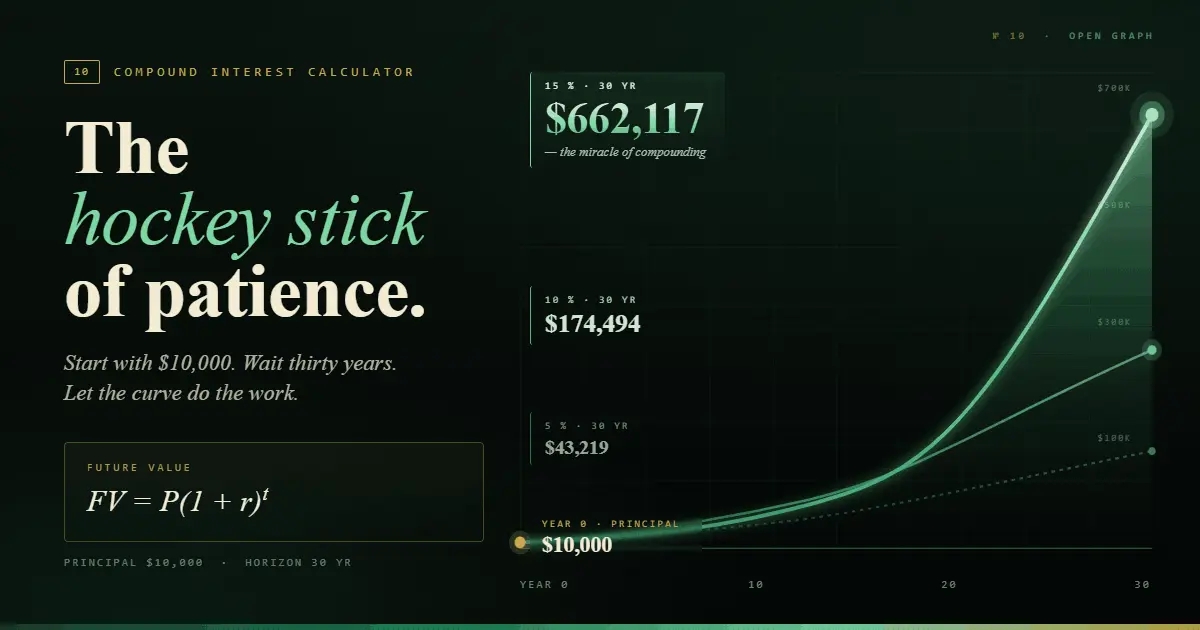
Suivez la croissance réelle de vos investissements
Les projections sont une première étape. L'outil de suivi du patrimoine net de Worthmap suit vos soldes réels dans chaque devise et les convertit dans une devise de base que vous choisissez, pour que vous voyiez comment votre argent grandit vraiment. Il est ouvert et vous pouvez l'essayer gratuitement. Le plan gratuit étant en version bêta, il peut arriver que vous rencontriez une erreur.
Créer un compte gratuitConçu et maintenu par Worthmap · Dernière mise à jour 29 septembre 2026
À usage pédagogique uniquement. Cet outil fournit des estimations à titre informatif et ne constitue pas un conseil financier, d'investissement, fiscal ou juridique. Les résultats reposent sur les données que vous saisissez et sur des modèles mathématiques ; ils ne garantissent pas les performances futures. Consultez toujours un conseiller financier qualifié avant de prendre des décisions d'investissement.