
Barwert-Rechner
Sehen Sie, was künftiges Geld heute wert ist
Geben Sie Betrag und Zinssatz ein
Kostenlos · Ohne Anmeldung · Aktualisiert beim Tippen
€
Die einzelne künftige Zahlung, z. B. 100.000.
Was dieses Geld anderswo einbringen könnte, z. B. 8 für 8 %. In der Finanzwelt heißt das Abzinsungssatz.
Wie weit in der Zukunft, in Jahren, z. B. 10. Höchstens 100.
Was €100.000 heute wert sind, wenn Sie 10 Jahre darauf warten
€46.319
Wenn Ihr Geld stattdessen 8 % pro Jahr einbringen könnte, sind €100.000, auf die Sie 10 Jahre warten, heute €46.319 wert (das ist ihr Barwert). Anders herum: €46.319, heute zu 8 % pro Jahr zurückgelegt, würden bis dahin auf €100.000 anwachsen. Bei dieser Rendite sind also mehr als €46.319 heute auf die Hand besser als Warten, weniger als €46.319 dagegen nicht.
Die Zahlen dahinter
Die Differenz
Was €46.319 über 10 Jahre bei 8 % pro Jahr einbringen würden. Das ist keine Gebühr, und niemand nimmt Ihnen das weg: Es ist der Grund, warum der spätere Betrag größer sein muss.
€53.681
Was das Ergebnis am stärksten verändert
Klicken Sie auf eine Zeile, um zu dem Feld zu springen, das Sie ändern würden.
Hier fließen nur die drei Zahlen oben ein. Steuern und steigende Preise sind nicht berücksichtigt, und die spätere Zahlung gilt als sicher.
Wie sich der Wert mit der möglichen Rendite verändert
Die Rendite, die Sie stattdessen erzielen könnten, ist eine Schätzung, und das Ergebnis verändert sich stark mit ihr. Hier ist dasselbe künftige Geld mit einer Spanne von Renditen bewertet.
| Mögliche Rendite pro Jahr | Wert heute |
|---|---|
| 4 % | €67.556 |
| 6 % | €55.839 |
| 8 % (Ihr Wert) | €46.319 |
| 10 % | €38.554 |
| 12 % | €32.197 |
Einblick: Der Barwert ist die Grundlage nahezu jeder Investitionsbewertung. Je höher der Abzinsungssatz oder je länger Sie warten, desto weniger ist ein künftiger Betrag heute wert. Wenn Sie zwei Optionen vergleichen, die sich zu unterschiedlichen Zeitpunkten auszahlen, stellt die Umrechnung beider in den Barwert sie auf eine gemeinsame Grundlage.
Der Barwert ist das Fundament des Zeitwerts des Geldes. Ein Dollar heute ist mehr wert als ein Dollar in der Zukunft, weil der heutige Dollar angelegt werden und eine Rendite erzielen kann. Dieser Rechner zinst künftige Cashflows auf ihren entsprechenden Wert heute ab.
PV = FV / (1 + r)^n
Schritt 1: Wählen Sie, ob Sie eine einzelne künftige Summe oder eine Reihe wiederkehrender Zahlungen (eine Rente) bewerten.
Schritt 2: Geben Sie den Betrag ein, den Sie erhalten werden (oder den Betrag jeder Zahlung), die jährliche Rendite, die Sie stattdessen erzielen könnten, und die Zahl der Jahre.
Schritt 3: Bei wiederkehrenden Zahlungen wählen Sie, wie oft Sie bezahlt werden: einmal im Jahr, alle sechs Monate, jedes Quartal oder jeden Monat. Eine einzelne künftige Summe wird einmal im Jahr abgezinst.
Schritt 4: Was das Geld heute wert ist, die Differenz und eine Tabelle mit anderen Renditen erscheinen schon beim Tippen, ganz ohne Knopfdruck.
Was ist der Barwert?
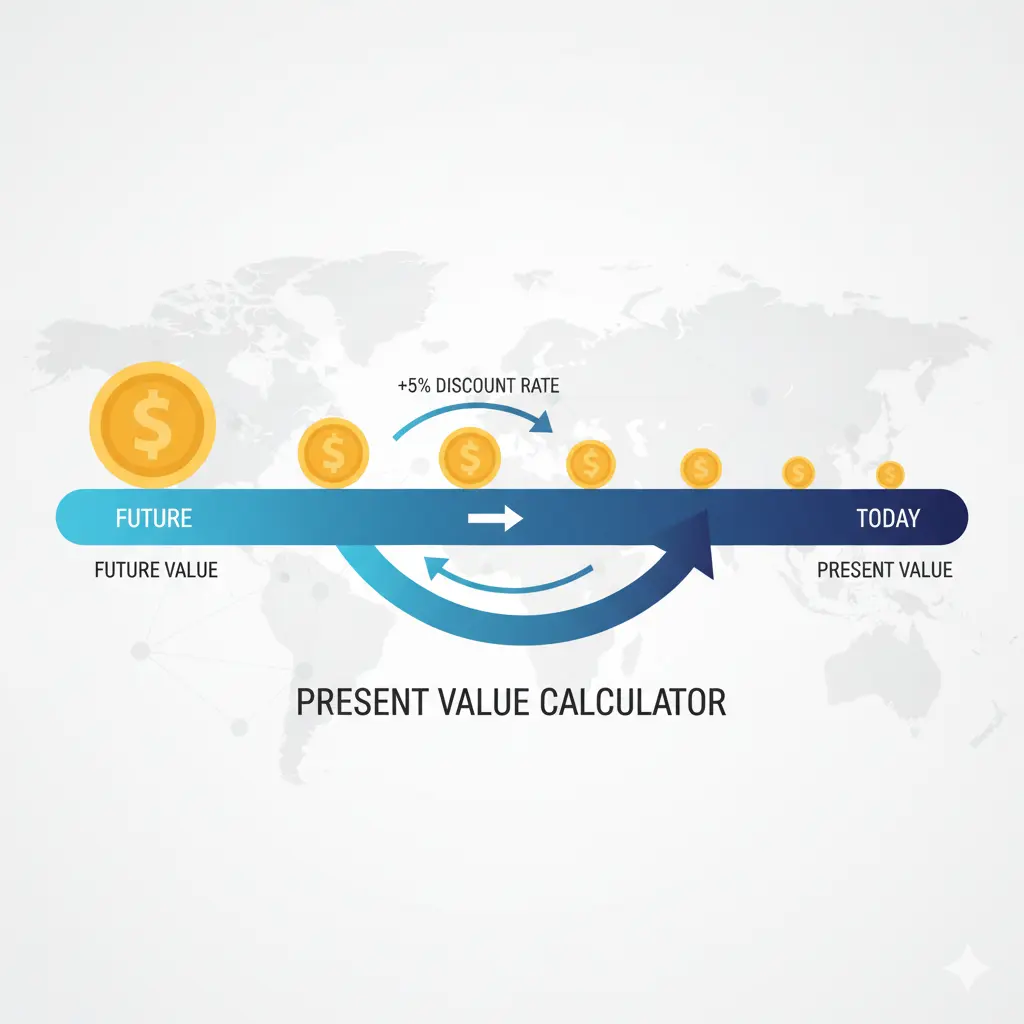
Der Barwert beantwortet eine einfache, aber wirkungsvolle Frage: Was ist ein künftiger Geldbetrag jetzt wert? Er beruht auf dem Zeitwert des Geldes, dem Gedanken, dass ein Dollar heute mehr wert ist als ein Dollar später, weil der Dollar, den Sie jetzt halten, angelegt werden und eine Rendite erzielen kann. Um Geld zu vergleichen, das zu unterschiedlichen Zeitpunkten eintrifft, müssen Sie es zunächst alles auf denselben Zeitpunkt zurückführen: auf heute.
Dieser Gedanke durchzieht fast die gesamte Finanzwelt. Er wird genutzt, um Anleihen zu bepreisen, die Cashflows eines Unternehmens zu bewerten, eine Einmalsumme mit einem Ratenplan zu vergleichen und zu entscheiden, ob eine künftige Auszahlung mehr wert ist als Geld in der Hand heute. Immer wenn der Zeitpunkt eines Zahlungsstroms eine Rolle spielt, ist der Barwert das Werkzeug, das gleiche Bedingungen schafft.
Die Barwert-Formel
PV = FV / (1 + r)^n
Für eine einzelne künftige Summe teilt der Barwert den künftigen Betrag durch eins plus den Jahressatz, potenziert mit der Anzahl der Jahre. Dieser Rechner zinst eine einzelne Summe einmal im Jahr ab. Je länger die Wartezeit und je höher der Satz, desto kleiner der Barwert.
Für eine Rente, eine Reihe gleicher Zahlungen in regelmäßigen Abständen, addiert der Barwert den abgezinsten Wert jeder einzelnen Zahlung. Statt jede Zahlung einzeln abzuzinsen, vereinfacht sich die Formel zu PV = PMT × [(1 − (1 + i)^−N) / i], wobei PMT eine Zahlung ist, i der Jahressatz geteilt durch die Anzahl der Zahlungen pro Jahr und N die Anzahl der Zahlungen. Jede Zahlung wird am Ende ihres Abstands gezählt. Mit dieser Formel rechnet der Rechner im Modus „Wiederkehrende Zahlungen“.
Ein durchgerechnetes Beispiel
Angenommen, jemand bietet Ihnen an, Ihnen in zehn Jahren $100.000 zu zahlen. Wenn Ihr Geld sonst 8 % pro Jahr einbringen könnte, beträgt der Barwert 100.000 ÷ (1,08)^10, was etwa $46.319 ergibt. Mit anderen Worten: Sie müssten heute nur rund $46.319 zurücklegen, die mit 8 % wachsen, um in einem Jahrzehnt bei $100.000 anzukommen. Die Differenz von etwa $53.681 ist das, was diese $46.319 in den zehn Jahren einbringen würden.
Nehmen Sie nun den Fall wiederkehrender Zahlungen: $1.000 pro Jahr über zehn Jahre zum selben Satz von 8 %. Die Zahlungen summieren sich auf dem Papier zu $10.000, doch ihr Barwert beträgt nur etwa $6.710, weil jede spätere Zahlung weniger wert ist als die davor. Die erste $1.000 muss kaum abgezinst werden; die zehnte wird um ein ganzes Jahrzehnt abgezinst. Deshalb ist ein Strom künftiger Einkünfte immer weniger wert als dieselbe Summe, die Sie heute erhalten.
Wie der Barwert beim Investieren genutzt wird
Die Bepreisung von Anleihen ist eine der direktesten Anwendungen. Der faire Preis einer Anleihe ist schlicht der Barwert ihrer künftigen Kuponzahlungen plus der Barwert des bei Fälligkeit zurückgezahlten Nennwerts. Das ist auch der Grund, warum Anleihekurse fallen, wenn die Zinsen steigen: Ein höherer Abzinsungssatz senkt den Barwert jeder künftigen Zahlung, die die Anleihe leisten wird.
Bei der Aktienbewertung schätzt das Discounted-Cashflow-Modell den Wert eines Unternehmens als den Barwert seiner prognostizierten künftigen freien Cashflows. Der Barwert klärt auch alltägliche Entscheidungen: Die Wahl zwischen $100.000 heute und $150.000 in fünf Jahren oder zwischen einer einmaligen Pensionsauszahlung und einer monatlichen Rente läuft darauf hinaus, jede Option zu einem realistischen Satz abzuzinsen und die Ergebnisse zu vergleichen.
Worauf Sie achten sollten
Das Ergebnis ist nur so gut wie der Abzinsungssatz, den Sie wählen, und dieser Satz ist eine Ermessensentscheidung, keine Tatsache. Eine kleine Änderung daran kann den Barwert erheblich verschieben, besonders über lange Zeiträume, genau deshalb zeigt der Rechner eine Sensitivitätstabelle über eine Spanne von Sätzen. Betrachten Sie den Barwert als wohlüberlegte Schätzung, nicht als exakte Zahl, und prüfen Sie stets, wie gut die Antwort standhält, falls Ihre Annahmen sich als etwas zu optimistisch erweisen.
Den Barwert zusammen mit anderen Werkzeugen nutzen
Der Barwert ist der Motor hinter mehreren anderen Werkzeugen. Um die Barwerte der Cashflows einer Investition zu addieren und ihre Anschaffungskosten abzuziehen, nutze unseren NPV-Rechner und um die prognostizierten Cashflows eines Unternehmens in einen Wert je Aktie umzurechnen, nutze den DCF-Rechner.
Der Abzinsungssatz, den Sie einsetzen, zählt mehr als jede andere Eingabe. Um einen realistischen Satz aus dem Mix aus Fremd- und Eigenkapital eines Unternehmens zu schätzen, berechnen Sie ihn mit unserem WACC-Rechner bevor Sie irgendwelche Cashflows auf heute abzinsen.
Häufig gestellte Fragen
Der Abzinsungssatz ist die Rendite, die Sie anderswo mit Geld vergleichbaren Risikos erzielen könnten, er hängt also davon ab, was Sie vergleichen. Für einen nahezu risikofreien Maßstab nehmen Sie die aktuelle Rendite einer Staatsanleihe, die ungefähr so lange läuft, wie Sie warten. Um ein Unternehmen oder eine Investition zu beurteilen, nehmen Sie Ihre geforderte Rendite oder die gewichteten durchschnittlichen Kapitalkosten (WACC). Wenn es Ihnen nur darum geht, mit den Preisen Schritt zu halten, nehmen Sie die Inflationsrate, die Sie erwarten. Der Barwert reagiert sehr empfindlich auf diese Zahl, daher lohnt es sich, eine Spanne auszuprobieren, statt einer einzigen Zahl zu vertrauen.
Der Barwert (PV) zinst einen einzelnen künftigen Betrag oder einen Strom gleicher Zahlungen auf seinen heutigen Wert ab. Der Nettobarwert (NPV) geht einen Schritt weiter: Er addiert die Barwerte aller Cashflows einer Investition und zieht dann die Anschaffungskosten ab, die Sie zahlen, um sie zu erhalten. Kurz gesagt: Der Barwert sagt Ihnen, was künftiges Geld heute wert ist; der Nettobarwert sagt Ihnen, ob eine Investition Wert schafft, nachdem Sie dafür bezahlt haben. Ein positiver Nettobarwert bedeutet, dass die erwartete Rendite Ihren Abzinsungssatz übersteigt.
Ja. Bei wiederkehrenden Zahlungen teilt dieser Rechner Ihren Jahressatz durch die Anzahl der Zahlungen pro Jahr. 8 % pro Jahr mit monatlichen Zahlungen werden also als 0,667 % pro Monat angesetzt, was sich zu etwa 8,30 % pro Jahr aufzinst. Das Ergebnis zeigt beide Zahlen. Eine einzelne künftige Summe wird hier immer einmal im Jahr abgezinst.
Nutzen Sie den Modus „Eine künftige Summe“, wenn es eine einzige künftige Zahlung gibt, zum Beispiel eine Anleihe, die bei Fälligkeit ihren Nennwert zurückzahlt, oder eine Auszahlung, die Sie in einigen Jahren einmalig erwarten. Nutzen Sie den Modus „Wiederkehrende Zahlungen“, wenn Sie denselben Betrag immer wieder in regelmäßigen Abständen erhalten, etwa eine Rente, eine feste jährliche Dividende oder Miete. Dort wählen Sie, wie oft Sie bezahlt werden, und der Betrag, den Sie eingeben, ist eine Zahlung: Wählen Sie „Jeden Monat“, wird er als monatliche Zahlung behandelt und am Ende jedes Monats gezählt.
Weil ein Dollar, den Sie heute in der Hand halten, angelegt werden kann, um eine Rendite zu erzielen, sodass er bis zum nächsten Jahr auf mehr als einen Dollar anwächst. Warten birgt zudem Risiko und kostet Sie in der Zwischenzeit die Nutzung des Geldes. Der Barwert dreht diese Logik einfach um: Er fragt, wie viel Sie heute zu Ihrem gewählten Satz zurücklegen müssten, um am Ende den künftigen Betrag zu erhalten. Je länger das Warten und je höher der Satz, desto weniger ist dieses künftige Geld jetzt wert.
Verfolgen Sie den Wert Ihres gesamten Portfolios
Den Barwert zu verstehen ist der erste Schritt. Mit einem kostenlosen Worthmap-Konto können Sie erfassen, was Sie in jeder Währung besitzen, Ihr Nettovermögen im Lauf der Zeit in einer Basiswährung sehen und den Aktienscreener sowie die KI-Analyse nutzen. Der kostenlose Tarif befindet sich in der Betaphase.
Kostenlos registrierenEntwickelt & gepflegt von Worthmap · Zuletzt aktualisiert 6. Oktober 2026
Nur zu Bildungszwecken. Dieses Tool liefert Schätzungen zu Informationszwecken und stellt keine Finanz-, Anlage-, Steuer- oder Rechtsberatung dar. Die Ergebnisse basieren auf den von Ihnen eingegebenen Daten und mathematischen Modellen, sie sind keine Garantie für zukünftige Wertentwicklungen. Konsultieren Sie stets einen qualifizierten Finanzberater, bevor Sie Anlageentscheidungen treffen.