
TL;DR
The six traps: fear & greed cycles, loss aversion, anchoring bias, herd mentality, FOMO, and recency bias. Contrarian antidote: use the Fear & Greed Index, put/call ratio, and short interest as buy signals when others panic. Graham's Mr. Market parable still applies, the market is your servant, not your advisor.
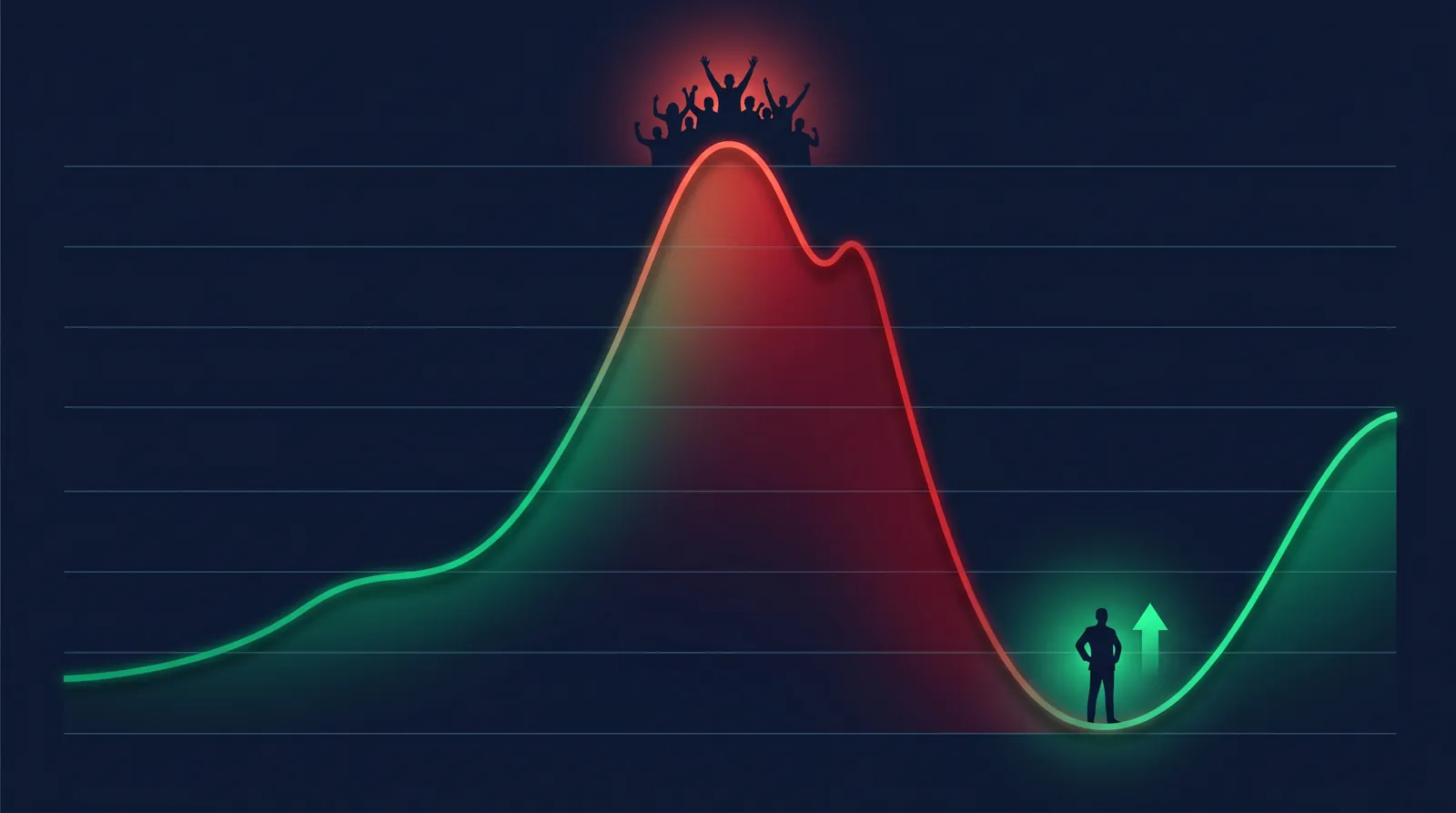
The average equity investor underperforms the market by 1.5-3% per year, according to DALBAR's Quantitative Analysis of Investor Behavior. The culprit is not bad stock picks. It is bad timing driven by emotions, buying high during euphoria and selling low during panic. Understanding investor psychology is not a soft skill. It is one of the most powerful edges available to a long-term investor.
Benjamin Graham introduced the "Mr. Market" parable in The Intelligent Investor (1949): imagine the market as a moody business partner who offers to buy or sell his share of your business every day at a different price, driven entirely by his mood. Some days he is euphoric and offers far too much. Other days he is terrified and will sell for almost nothing. The intelligent investor does not follow Mr. Market's lead, he exploits it.
The Fear and Greed Cycle
Markets move in emotional cycles. When prices rise, optimism builds, new investors pile in, and media coverage turns positive. Greed pushes valuations beyond fundamentals. When a catalyst triggers a reversal, a rate hike, a geopolitical shock, a disappointing earnings report, fear takes over. Investors sell indiscriminately, often at the worst possible moment.
Human brains are not wired for probabilistic thinking about markets. We evolved to treat loss as more painful than equivalent gain is pleasurable, a cognitive feature called loss aversion, documented by Daniel Kahneman and Amos Tversky in Prospect Theory (1979). A $1,000 loss feels roughly twice as painful as a $1,000 gain feels good. This asymmetry causes investors to hold losers too long and sell winners too early.
Six Core Psychological Traps
1. Loss Aversion
Loss aversion causes investors to hold a stock that has fallen 40% because selling would make the loss "real", even when the capital could be better deployed elsewhere. Kahneman's research shows that only when a loss becomes extremely large do investors finally capitulate, by then, the damage is done. The tax code actually rewards harvesting losses, yet many investors avoid it psychologically.
2. Anchoring Bias
Anchoring occurs when investors fix on an arbitrary reference price and make decisions relative to it. "I'll sell when I get back to $100", even when the fundamentals justify a price of $70. Or "it was $200 last year, so $140 seems cheap", even when earnings have collapsed. The anchor is irrelevant to intrinsic value, yet it dominates decision-making. Value investors discipline themselves to anchor on estimated intrinsic value, not past market prices.
3. Herd Mentality
Humans are social animals. In financial markets, this manifests as herding, buying what others are buying, selling what others are selling. Herding is reinforced by career risk in institutional investing and by the comfort of social validation. Momentum strategies exploit herding on the way up; contrarian strategies exploit the inevitable reversal.
4. FOMO (Fear of Missing Out)
FOMO drives investors into assets at precisely the wrong time, after a sustained rally, when valuations are stretched and the easy money has been made. The 1999 dot-com bubble, the 2021 crypto mania, and every meme stock spike show the same pattern: retail investors flood in as prices peak, lured by coverage of others' gains. The antidote is a consistent valuation discipline: if you cannot justify the price with fundamentals, the rally is not for you.
5. Recency Bias
Recency bias causes investors to extrapolate recent trends indefinitely into the future. After three years of a bull market, investors assume equities always rise. After a crash, they assume stocks will continue falling. Both assumptions are wrong, but both feel intuitively correct because recent experience is most salient. Richard Thaler's research on mental accounting shows that investors categorize money by its recent history rather than treating it as fungible.
6. Overconfidence
Most investors believe they are above-average stock pickers, a statistical impossibility. Brad Barber and Terrance Odean's landmark study of 66,465 investor accounts found that the most active traders underperformed the least active by 6.5% annually, largely due to transaction costs and poor timing. Activity feels productive. In investing, it often destroys value.
Reading Market Sentiment as a Contrarian Signal
Warren Buffett's most cited rule, "be fearful when others are greedy, and greedy when others are fearful", is the foundation of contrarian investing. But acting on it requires measuring collective sentiment objectively, not just by feel. Several indicators help.
The Fear & Greed Index
CNN's Fear & Greed Index aggregates seven market signals: stock price momentum, strength, breadth, put/call ratio, junk bond demand, market volatility (VIX), and safe-haven demand. It produces a 0-100 score. Readings below 25 (Extreme Fear) have historically coincided with attractive buying opportunities. Readings above 75 (Extreme Greed) have often preceded corrections. It is not a precise timing tool, but it provides context for positioning decisions.

Put/Call Ratio
The put/call ratio divides the number of put options traded by the number of call options. A high ratio (above 1.0) indicates that investors are buying more downside protection, a sign of widespread bearish sentiment. Contrarians read this as evidence that pessimism is already priced in, reducing downside risk. A low ratio (below 0.7) signals complacency, investors are not adequately hedged and the market may be vulnerable.
Short Interest
Short interest, the percentage of a stock's float sold short, measures bearish conviction among professional investors. Extremely high short interest in a fundamentally sound company can be a contrarian signal: if the bear thesis is wrong, short covering amplifies any price recovery. However, high short interest in a legitimately troubled company is usually warranted, always evaluate the fundamental thesis before acting on it.
Try the Margin of Safety Calculator
The Mr. Market Framework in Practice
Graham's Mr. Market parable teaches an actionable lesson: treat market prices as information about sentiment, not information about value. When Mr. Market is euphoric and offers a price well above your estimate of intrinsic value, sell or trim. When he is depressed and offers a price well below intrinsic value, buy. When his price is roughly fair, do nothing.
This requires two things most investors lack: (1) a reliable estimate of intrinsic value, and (2) the emotional discipline to act when the crowd moves in the opposite direction. The Graham Number and Margin of Safety calculators address the first. Pre-commitment frameworks, checklists, pre-defined buy/sell criteria, standing buy orders at target prices, address the second by removing in-the-moment emotional decision-making.
Portfolio rebalancing is a built-in contrarian mechanism. By systematically selling assets that have risen above target allocation and buying those that have fallen below, rebalancing forces buy-low/sell-high behavior without requiring a market call. It turns emotional discomfort, buying more of what has fallen, into a systematic rule.
Behavioral Finance: Key Insights
Confirmation bias leads investors to seek information that validates existing positions and dismiss evidence that challenges them. An investor bullish on a stock reads bullish reports and ignores bearish ones. The discipline of actively seeking out the strongest bear case for every holding is a practical antidote.
Mental accounting causes investors to treat money differently depending on its origin. "House money" (profits) is spent more freely than earned capital. These distinctions are economically irrational but psychologically powerful. Every dollar has the same opportunity cost regardless of where it came from.
Sunk cost fallacy keeps investors in bad positions because of what they have already invested. "I've already lost $30,000 on this stock, I can't sell now." The rational question is always: if I had cash equivalent to the current position value, would I deploy it into this asset at this price?
Building Psychological Defenses
Knowing about biases does not eliminate them, even Kahneman himself reports falling prey to the cognitive errors he spent his career studying. The effective response is to build systems that reduce the influence of in-the-moment emotion. An investment policy statement (IPS) defines objectives, risk tolerance, and rebalancing rules before a crisis occurs. When markets fall 30%, you consult the IPS rather than your fear.
A decision journal, recording the reasoning behind every buy and sell at the time of the decision, creates an honest record that counters hindsight bias. The discomfort of reviewing past reasoning errors is one of the most effective teachers available to any investor.
Try the Graham Number Calculator
Try the Portfolio Rebalancing Calculator
Try the Dividend Calculator
Disclaimer
This article is for educational purposes only. It does not constitute investment advice. All investments involve risk, including the risk of total loss. The psychological frameworks described here are tools for improving decision quality, they do not guarantee profitable outcomes. Consult a qualified financial adviser before making any investment decision.
Worthmap combines a free portfolio tracker with a stock screener and AI analysis at my.worthmap.com, and free valuation calculators on the site, to support rational, fundamentals-based investing rather than emotional market-timing.
Create free accountSummary
Fear, greed and bias cost the average investor 1-3% a year in returns. The six psychological traps, and how contrarian thinking turns panic into opportunity.

Written by
Federico RomaldiCo-Founder, Worthmap
Published: April 30, 2026
Federico is a co-founder of Worthmap, a multi-currency net worth tracker with free investing calculators. He writes the site’s articles on value investing, fundamental analysis and tracking wealth held in several currencies. He is not a licensed financial adviser.
Comments
Be the first to comment on this article.
Related Articles
Educational content only. This article is for informational and educational purposes and does not constitute financial, investment, tax, or legal advice. Worthmap is a wealth-tracking and analysis tool, not a registered investment adviser or broker-dealer. Markets carry risk and past performance does not guarantee future results. Always do your own research and consult a qualified financial adviser before making investment decisions.