
WACC计算器
任何公司的加权平均资本成本
填入五个数字,看看这家公司每年至少要赚到多少回报
免费 · 无需注册 · 实时更新
公司的钱从哪里来
去哪里找这个数字
去哪里找这个数字
股东要求多少回报
这个数字是什么意思
CAPM 是怎么算的
%
去哪里找这个数字
这个数字是什么意思
%
这个数字是什么意思
估算的股权成本: 9.00%
改动这三个数字中的任何一个,上面的“股东要求的回报率”一栏都会自动跟着更新。
借款的成本
去哪里找这个数字
选择国家会怎样
这个数字是什么意思
这家公司每年至少要赚到的回报(即 WACC)
7.56%
这是股东和债权人合起来要求的回报,按双方各投入多少资金加权。做 DCF 时就用它作折现率:一门生意或一个项目,每年赚得比 7.56% 多就是在创造价值,比它少就是在损耗价值。
这个结论背后的数字
股东这一块
他们提供了 71.4% 的资金,每年要求 9.0% 的回报。9.0% 乘以 71.4%,得到 6.43%。
6.43%
债权人这一块
他们提供了 28.6% 的资金,利率 5.0%。利息可以抵税,税率 21.0% 时,实际成本是 3.95%。3.95% 乘以 28.6%,得到 1.13%。
1.13%
两块合计
6.43% 加上 1.13%。
7.56%
公司的钱从哪里来
股东 71.4%
债权人 28.6%
哪些数字会让结果变化
点一下其中一条,页面就会跳到它说的那个输入框。
- 股东要求的回报是这里唯一需要你自己估的数字。如果它是 10.0% 而不是 9.0%,公司每年就要赚到 8.27%。
- 如果借款利率是 6.0% 而不是 5.0%,公司每年就要赚到 7.78%。
- 如果利息不能抵税,公司每年就要赚到 7.86%。抵税让这个数字降低了 0.30 个百分点。
如果股权成本估得不准,结果会差多少?
这几个数字里,只有股权成本得靠你自己估,其他的基本都能直接查到,所以值得看看结果有多依赖它。下面这张表里,其他数字都不动,还是你填的那些,只让股权成本上下浮动。
| 假设股权成本 | WACC就变成 |
|---|---|
| 7.0% | 6.13% |
| 8.0% | 6.84% |
| 9.0%你填的 | 7.56% |
| 10.0% | 8.27% |
| 11.0% | 8.99% |
只要公司还有债务,股权成本每变动1个百分点,WACC跟着变动的幅度就不到1个百分点,因为债务那一块没有动。股权占的比重越大,WACC就越跟着股权成本走。
洞察:公司的WACC代表其必须在现有资产上获得的最低回报,以满足债权人、所有者和其他资本提供者。
WACC是公司预计为融资其资产而支付的平均利率。它混合了股权成本和税后债务成本。
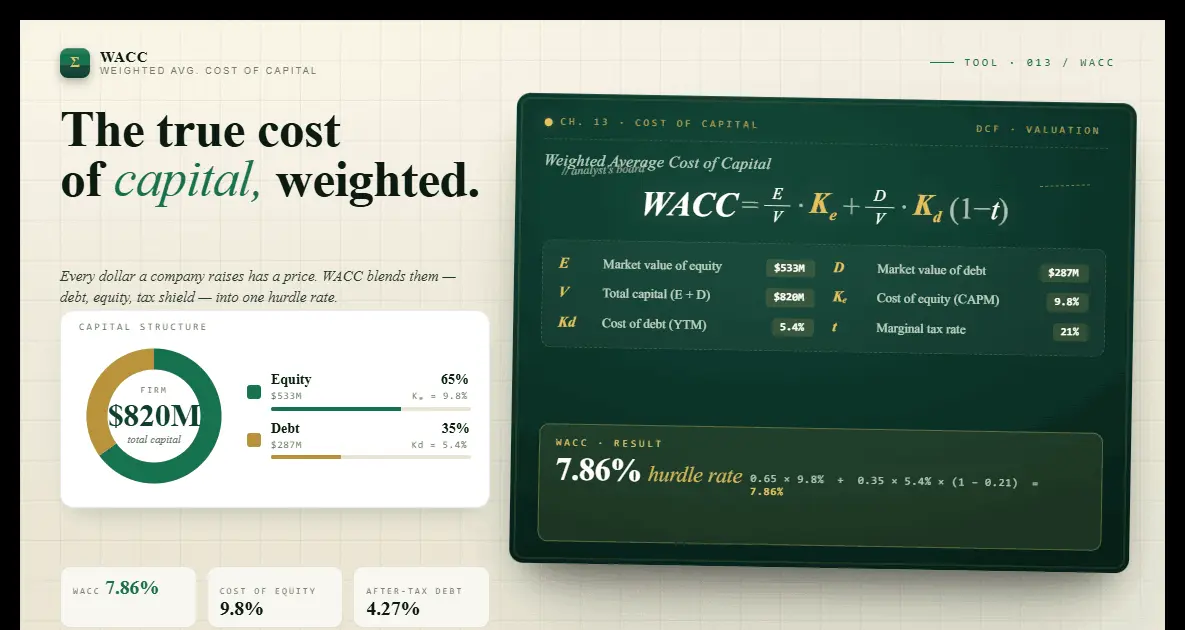
WACC = (E/V × Re) + (D/V × Rd × (1 − T))
步骤 1: 输入股权市场价值(市值)和债务市场价值。
步骤 2: 输入股权成本(通常使用CAPM估算)。
步骤 3: 输入债务成本和企业税率。
步骤 4: 这里没有“计算”按钮。你一边输入,WACC、股权与债务权重以及各自的贡献占比就一边更新:改动任何一个数字,结果立刻跟着变。
什么是WACC?
WACC是公司金融中最重要的指标之一。它代表公司通过股权和债务组合融资运营所支付的混合成本。
WACC在DCF分析中被广泛用作折现率。更高的WACC意味着未来现金流在今天价值更低。想从头把每一项输入都弄清楚,可以看我们的 WACC 完整指南,它把同一个公式一步一步拆开讲。
WACC公式详解
WACC = (E/V × Re) + (D/V × Rd × (1 − T))
该公式按每种资本来源在总资本结构中的比例进行加权。
股权成本通常使用CAPM估算。
WACC如何使用?
分析师使用WACC作为DCF模型中的折现率。
管理者使用WACC作为资本预算决策的门槛利率。真要拿这里算出的折现率去折现一串现金流,又是另一门功课,我们关于用 WACC 作 DCF 折现率的指南讲清了折现与终值怎么衔接,以及为什么 WACC 差半个百分点,估值就会差出一大截。
WACC的局限性
WACC假设资本结构不变。实际上会随时间变化。
WACC对于资本结构稳定的成熟公司最为可靠。
WACC计算器常见问题
WACC 是加权平均资本成本。公司用的钱一部分来自借款,一部分来自股东,WACC 就是按两者各占多少加权算出的综合资金价格。它之所以重要,是因为做 DCF 估值时用的折现率就是它,公司上马新项目时要跨过的门槛也是它。一家公司如果长期赚得比自己的 WACC 还少,即使账面上有利润,实际上也在消耗股东的价值。
WACC =(E/V × Re)+(D/V × Rd ×(1 − T))。E 是股权的市场价值,D 是债务的市场价值,V 是两者之和,Re 是股权成本,Rd 是税前债务成本,T 是企业所得税率。以上面已经填好的例子来看:股权 5 亿美元、债务 2 亿美元,也就是股权提供了 71.4% 的资金,债务提供 28.6%。股权贡献 0.714 × 9% = 6.43%,债务贡献 0.286 × 5% ×(1 − 0.21)= 1.13%,两者相加就是 7.56% 的 WACC。
最常用的是 CAPM:股权成本 = 无风险利率 + 贝塔 ×(市场回报率 − 无风险利率)。无风险利率一般取 10 年期国债收益率。贝塔衡量这只股票跟随大盘波动的幅度,在多数行情页面都能查到。市场回报率与无风险利率之间的差额就是股权风险溢价,视市场和数据来源不同,通常按 4% 到 6% 左右假设。本页上方的 CAPM 小工具会替你把这笔账算好,并把结果直接填进股权成本一栏。
没有一个放之四海而皆准的好数字,因为 WACC 取决于生意本身的风险,以及背后债务与股权的比例。多数成熟公司大致落在 6% 到 12% 之间。公用事业和必需消费品经营稳定,能以较低利率借到大量资金,通常在区间下端;年轻的科技公司主要靠要求高回报的股权融资,通常在上端。真正有意义的比较不是和别的公司比,而是和这家公司自己的投入资本回报率比:高于 WACC 就在创造价值,低于 WACC 就在损耗价值。
利息是可以在缴税前扣除的费用,所以借钱的实际成本比票面利率低。按上面的例子,5% 的利率遇上 21% 的税率,税后债务成本就是 5% ×(1 − 0.21)= 3.95%。付给股东的股息则没有这项扣除,这就是公式里债务看起来比股权便宜的原因,也是几乎每家大公司都会保留一部分债务的原因。不过这项好处只有在公司赚到足够利润、用得上这项扣除时才真正存在。
CAPM 和贝塔系数如何决定 WACC 中的股权成本
资本资产定价模型(CAPM)是 WACC 公式中估算股权成本的标准方法。CAPM 公式为:Re = Rf + β × (Rm − Rf),其中 Rf 是无风险利率(通常为 10 年期国债收益率),β(贝塔)是该股票相对于市场的系统性风险,(Rm − Rf) 是股权风险溢价。贝塔小于 1 表示股票波动小于市场;贝塔大于 1 表示它会放大市场波动。贝塔计算器可帮助你根据历史价格数据估算这一指标。如果这些名词对你还很陌生,词汇表里的 CAPM 词条用一段话给出定义,还配了一个算例。
在实践中,分析师以行业贝塔(也称无杠杆贝塔或资产贝塔)作为起点,再根据公司具体的债务股权比重新加杠杆。这可以避免股权成本的估算被公司的资本结构所扭曲。重新加杠杆使用哈马达方程:βL = βU × [1 + (1 − T) × (D/E)],其中 T 是税率,D/E 是债务股权比。这正是同一个 WACC 计算器既可用作 CAPM 计算器(求 Re),又可用作资本结构优化工具的原因。想看更详细的版本,包括贝塔到底衡量什么、它会把最终结果拉动多少,我们关于股权成本的文章用一个完整算例拆给你看。
企业价值和 EV/EBITDA 倍数与 WACC 的关系
企业价值(EV)是一家企业的总价值,即理论上的收购价格。EV = 市值 + 总债务 − 现金及现金等价物。与市值不同,EV 计入了公司的债务负担,因而更完整地反映了你收购一家企业时实际支付的代价。企业价值计算器对于比较资本结构不同的公司至关重要:一家高债务、低市值的公司,其实际价值可能低于市值所显示的水平。
EBITDA(息税折旧及摊销前利润)是相对估值中最常用的分母。EV/EBITDA 倍数(企业价值除以 EBITDA)用于跨行业比较公司,因为它对资本结构中性,并消除了不同税率和会计折旧选择的影响。EBITDA 计算器从营业利润(EBIT)出发,加回折旧与摊销。WACC 是基于 EBITDA 的倍数与 DCF 分析之间的桥梁:在 DCF 模型中,WACC 将自由现金流(由 EBITDA 减去资本支出、税款和营运资金变动得出)折现回其现值。
由 Worthmap 打造并维护 · 最后更新 2026年9月29日
仅供教育参考。 本工具提供的估算仅供参考,不构成财务、投资、税务或法律建议。结果基于你输入的数据和数学模型,并不保证未来表现。在做出投资决策前,请务必咨询合格的财务顾问。