
Calcolatore WACC
Costo medio ponderato del capitale per qualsiasi azienda
Inserisci cinque numeri e scopri il rendimento che questa azienda deve ottenere
Gratis · Senza registrazione · Si aggiorna mentre digiti
Chi finanzia l'azienda
Dove trovarlo
Dove trovarlo
Quanto si aspettano gli azionisti
Che cosa significa questo numero
Come funziona il CAPM
%
Dove trovarlo
Che cosa significa questo numero
%
Che cosa significa questo numero
Costo del capitale stimato: 9,00%
Cambia uno di questi tre numeri e il campo Rendimento atteso dagli azionisti qui sopra si aggiorna da solo.
Quanto costano i prestiti
Dove trovarlo
Che cosa succede se scegli un paese
Che cosa significa questo numero
Il rendimento che l'azienda deve ottenere ogni anno (il suo WACC)
7,56%
È il rendimento che si aspettano insieme gli azionisti e chi presta i soldi, pesato in base a quanti soldi ha messo ciascuno. Usalo come tasso di sconto in un DCF: un'attività o un progetto che rende più di 7,56% all'anno crea valore, uno che rende meno lo distrugge.
I numeri dietro a questa risposta
La parte degli azionisti
Coprono una quota di 71,4% dei soldi e chiedono un rendimento di 9,0% all'anno. 9,0% moltiplicato per 71,4% fa 6,43%.
6,43%
La parte di chi presta i soldi
Coprono una quota di 28,6% dei soldi, a un tasso di 5,0%. Gli interessi si deducono dalle tasse, quindi con un'aliquota di 21,0% il debito costa davvero 3,95%. 3,95% moltiplicato per 28,6% fa 1,13%.
1,13%
In tutto
6,43% più 1,13%.
7,56%
Chi finanzia l'azienda
Azionisti 71,4%
Chi presta i soldi 28,6%
Che cosa sposta questo numero
Clicca su una riga per andare dritto al campo di cui parla.
- Il rendimento che si aspettano gli azionisti è l'unico numero qui che devi stimare tu. Con un rendimento atteso di 10,0% invece di 9,0%, l'azienda dovrebbe ottenere un rendimento di 8,27%.
- Con un tasso sui prestiti di 6,0% invece di 5,0%, l'azienda dovrebbe ottenere un rendimento di 7,78%.
- Se gli interessi non si potessero dedurre dalle tasse, l'azienda dovrebbe ottenere un rendimento di 7,86%. La deduzione lo abbassa di 0,30 punti percentuali.
E se avessi sbagliato la stima del costo del capitale proprio?
Il costo del capitale proprio è l'unico numero qui che devi stimare tu (gli altri li leggi da qualche parte), quindi vale la pena vedere quanto il risultato dipende da quella stima. Nella tabella tutto il resto resta com'è, con i tuoi numeri: si muove solo il costo del capitale proprio.
| Se il costo del capitale proprio è | il tuo WACC diventa |
|---|---|
| 7,0% | 6,13% |
| 8,0% | 6,84% |
| 9,0%il tuo valore | 7,56% |
| 10,0% | 8,27% |
| 11,0% | 8,99% |
Se l'azienda ha dei debiti, un punto percentuale in più o in meno sul costo del capitale proprio sposta il WACC di meno di un punto, perché il capitale proprio finanzia solo una parte dell'azienda. Più grande è quella parte, più il WACC segue da vicino quel costo. In un'azienda senza debiti i due si spostano punto per punto.
Approfondimento: Il WACC di un'azienda rappresenta il rendimento minimo che deve guadagnare sugli asset esistenti per soddisfare creditori, proprietari e altri fornitori di capitale.
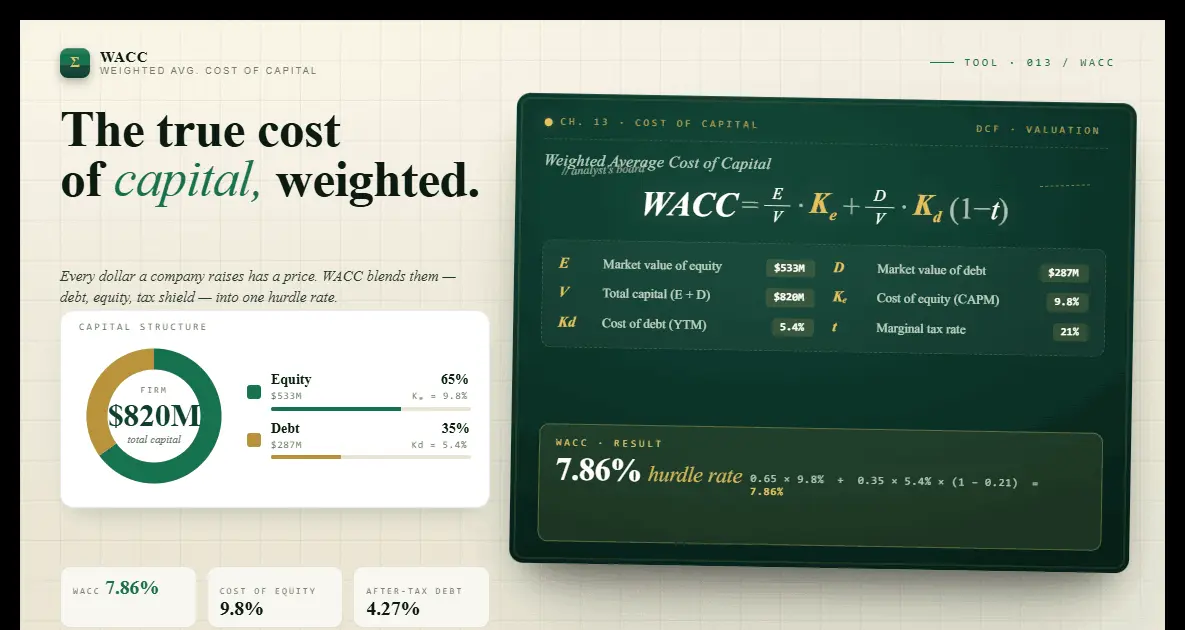
Il WACC è il tasso medio che un'azienda dovrebbe pagare per finanziare i propri asset. Mescola il costo dell'equity e il costo del debito al netto delle imposte.
WACC = (E/V × Re) + (D/V × Rd × (1 − T))
Passo 1: Inserisci il valore di mercato dell'equity e il valore di mercato del debito.
Passo 2: Inserisci il costo dell'equity (spesso stimato tramite CAPM).
Passo 3: Inserisci il costo del debito e l'aliquota fiscale aziendale.
Passo 4: Non c'è nessun pulsante Calcola: il WACC, i pesi di capitale proprio e debito e la ripartizione dei contributi si aggiornano mentre scrivi. Prova a cambiare un numero e guarda il risultato.
Cos'è il WACC?
Il WACC è una delle metriche più importanti nella finanza aziendale. Rappresenta il costo misto che un'azienda paga per finanziare le sue operazioni.
Il WACC è ampiamente utilizzato nell'analisi DCF come tasso di sconto. Un WACC più alto significa che i flussi di cassa futuri valgono meno oggi. Se preferisci partire da zero, con ogni voce spiegata, la nostra guida semplice al WACC ripercorre la stessa formula passo dopo passo.
La formula del WACC spiegata
WACC = (E/V × Re) + (D/V × Rd × (1 − T))
La formula pondera ogni fonte di capitale per la sua proporzione nella struttura totale.
Il costo dell'equity è tipicamente stimato utilizzando il CAPM.
Come viene utilizzato il WACC?
Gli analisti usano il WACC come tasso di sconto nei modelli DCF.
I manager usano il WACC come tasso soglia per decisioni di capital budgeting. Scontare davvero una serie di flussi di cassa con il tasso che ottieni qui è un lavoro a parte, e la nostra guida su come usare il WACC come tasso di sconto in un DCF spiega come si incastrano lo sconto e il valore terminale, e perché mezzo punto di WACC sposta così tanto la valutazione.
Limitazioni del WACC
Il WACC assume una struttura del capitale costante. In realtà cambia nel tempo.
Il WACC è più affidabile per aziende consolidate con strutture stabili.
Domande frequenti sul calcolatore WACC
WACC sta per costo medio ponderato del capitale. È il prezzo misto che un'azienda paga per i soldi che usa: una parte presi a prestito, una parte messi dai soci, pesati in base a quanto ce n'è di ciascuno. Conta perché lo stesso numero è il tasso con cui si sconta un DCF ed è l'asticella che ogni nuovo progetto deve superare. Un'azienda che rende meno del proprio WACC sta distruggendo valore, anche se a bilancio mostra un utile.
WACC = (E/V × Re) + (D/V × Rd × (1 − T)). E è il valore di mercato del capitale proprio, D quello del debito, V è E più D, Re è il costo del capitale proprio, Rd il costo del debito prima delle imposte e T l'aliquota fiscale. Guarda l'esempio già compilato qui sopra: 500 milioni di capitale proprio e 200 milioni di debito, quindi il capitale proprio finanzia il 71,4% dell'azienda e il debito il 28,6%. Il capitale proprio contribuisce con 0,714 × 9% = 6,43%, il debito con 0,286 × 5% × (1 − 0,21) = 1,13%, e la somma dei due dà un WACC del 7,56%.
Quasi tutti usano il CAPM: costo del capitale proprio = tasso privo di rischio + beta × (rendimento di mercato − tasso privo di rischio). Come tasso privo di rischio si prende di solito il rendimento del titolo di Stato a 10 anni. Il beta dice quanto l'azione si muove insieme al mercato e lo trovi sulla scheda dati di quasi ogni titolo. La differenza tra rendimento di mercato e tasso privo di rischio è il premio per il rischio azionario, che di solito si assume tra il 4% e il 6% a seconda del mercato e della fonte che usi. Il riquadro CAPM qui sopra fa il conto al posto tuo e scrive il risultato direttamente nel campo del costo del capitale proprio.
Non esiste un numero buono in assoluto, perché il WACC segue il rischio dell'attività e il mix di debito e capitale proprio che la finanzia. La maggior parte delle aziende consolidate si colloca più o meno tra il 6% e il 12%. Le utility e i beni di consumo di base, stabili e con molto debito a basso costo, stanno in fondo alla forchetta. Le società tecnologiche giovani, finanziate quasi solo con capitale proprio che pretende rendimenti alti, stanno in cima. Il confronto che dice davvero qualcosa non è con le altre aziende ma con il rendimento del capitale investito della stessa azienda: se rende più del WACC crea valore, se rende meno lo distrugge.
Gli interessi sono un costo che l'azienda deduce prima di pagare le tasse, quindi indebitarsi costa meno di quanto dica il tasso nominale. Nell'esempio qui sopra, un tasso del 5% e un'aliquota del 21% danno un costo del debito al netto delle imposte pari a 5% × (1 − 0,21) = 3,95%. I dividendi pagati ai soci non danno nessuna deduzione: per questo nella formula il debito sembra più economico del capitale proprio, ed è il motivo per cui quasi ogni grande azienda ne tiene un po'. Il risparmio però esiste solo finché l'azienda produce utili sufficienti a sfruttare la deduzione.
Come il CAPM e il beta determinano il costo del capitale proprio nel WACC
Il Capital Asset Pricing Model (CAPM) è il metodo standard per stimare il costo del capitale proprio nella formula del WACC. La formula del CAPM è: Re = Rf + β × (Rm − Rf), dove Rf è il tasso privo di rischio (di solito il rendimento del titolo di Stato a 10 anni), β (beta) è il rischio sistematico del titolo rispetto al mercato e (Rm − Rf) è il premio per il rischio azionario. Un beta inferiore a 1 indica che il titolo si muove meno del mercato; un beta superiore a 1 indica che ne amplifica i movimenti. Un calcolatore del beta ti aiuta a stimare questo dato a partire dai prezzi storici. Se questi termini ti sono nuovi, la voce CAPM del nostro glossario ne dà la definizione breve con un esempio numerico.
In pratica, gli analisti partono dal beta di settore (detto anche beta unlevered o asset beta) e lo rilevano in base allo specifico rapporto debito/capitale proprio dell'azienda. Questo evita che la stima del costo del capitale proprio venga distorta dalla struttura finanziaria. Il rilievo usa l'equazione di Hamada: βL = βU × [1 + (1 − T) × (D/E)], dove T è l'aliquota fiscale e D/E è il rapporto debito/capitale proprio. È per questo che lo stesso calcolatore del WACC funge sia da calcolatore CAPM (per ottenere Re) sia da strumento di ottimizzazione della struttura finanziaria. Per la versione lunga, compreso che cosa misura davvero il beta e quanto sposta il risultato finale, il nostro articolo sul costo del capitale proprio lo smonta pezzo per pezzo con un esempio pratico.
Come il valore d'impresa e i multipli EV/EBITDA si legano al WACC
Il valore d'impresa (EV) è il valore totale di un'azienda, ovvero il prezzo teorico di acquisizione. EV = capitalizzazione di mercato + debito totale − liquidità e disponibilità equivalenti. A differenza della capitalizzazione, l'EV tiene conto dell'indebitamento dell'azienda, offrendo una misura più completa di ciò che paghi davvero quando acquisti un'impresa. Un calcolatore del valore d'impresa è essenziale per confrontare aziende con strutture finanziarie diverse: una società con debito elevato e bassa capitalizzazione può valere meno di quanto la capitalizzazione suggerisca.
L'EBITDA (utile prima di interessi, imposte, svalutazioni e ammortamenti) è il denominatore più comune nella valutazione relativa. Il multiplo EV/EBITDA (valore d'impresa diviso EBITDA) serve a confrontare aziende di settori diversi perché è neutro rispetto alla struttura finanziaria ed elimina gli effetti delle diverse aliquote fiscali e delle scelte contabili di ammortamento. Un calcolatore dell'EBITDA parte dal reddito operativo (EBIT) e vi riaggiunge svalutazioni e ammortamenti. Il WACC è il ponte tra i multipli basati sull'EBITDA e l'analisi DCF: in un modello DCF, il WACC sconta i flussi di cassa liberi (derivati dall'EBITDA meno capex, imposte e variazioni del capitale circolante) riportandoli al valore attuale.
Porta la tua analisi finanziaria oltre
Il WACC è un elemento fondamentale della valutazione professionale. Combinalo con il monitoraggio del portafoglio su Worthmap.
Crea account gratuitoCreato e gestito da Worthmap · Ultimo aggiornamento 29 settembre 2026
Solo a scopo didattico. Questo strumento fornisce stime a scopo informativo e non costituisce consulenza finanziaria, di investimento, fiscale o legale. I risultati si basano sui dati che inserisci e su modelli matematici e non garantiscono performance future. Consulta sempre un consulente finanziario qualificato prima di prendere decisioni di investimento.